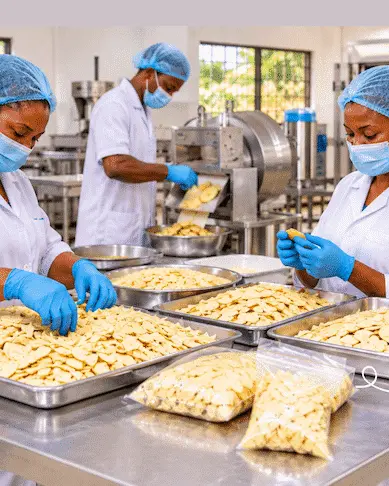
Food Processing in Nigeria: Methods, Machines, Food Safety and Quality Control.
Food processing in Nigeria plays an important role in preserving agricultural produce, reducing food losses, improving food availability and creating business opportunities across the food value chain. From transforming cassava into garri and fresh plantain into flour to drying pepper, milling grains, packaging dried vegetables and also packaging dried fruits as snacks, food processing helps turn agricultural raw materials into products that are easier to store, transport, prepare and consume.
Nigeria has a wide variety of agricultural products, including cassava, maize, rice, sorghum, millet, plantain, fruits, vegetables, fish and spices. However, the value of these resources is not determined by production alone. How food is handled, processed, preserved, packaged and stored also matters.
For farmers, food processors, manufacturers, restaurants, agricultural entrepreneurs and consumers, understanding food processing is essential. Good processing practices can help maintain product quality, improve shelf life, reduce avoidable waste and support food safety.
This guide explains what food processing means, the common methods used in Nigeria, the role of machinery, the importance of hygiene and quality control, and the opportunities available in the food processing industry.
What Is Food Processing?
Food processing refers to the methods and techniques used to transform raw agricultural materials and other food ingredients into food products suitable for consumption, storage, distribution or further manufacturing.
Food Processing methods can be as simple as sorting, washing, peeling, cutting and drying. It can also involve more advanced operations such as milling, fermentation, pasteurization, freezing, mixing, extrusion and packaging.
For example:
– Cassava can be processed into garri, fufu, starch and cassava flour.
– Plantain can be processed into flour, chips and other products.
– Maize can be milled into flour or processed into other food products.
– Sorghum can be processed into flour and traditional fermented foods such as pap or swallow.
– Pepper can be cleaned, dried, milled and packaged as a spice.
– Fish and seafood can be smoked, dried, frozen or otherwise preserved.
Food processing does not always mean changing the original nature of a food. Some processes are intended mainly to improve cleanliness, remove unwanted materials, make food easier to use or extend its storage life.
Why Is Food Processing Important in Nigeria?
Food processing is important because it connects agricultural production with consumers, retailers, restaurants and food manufacturing businesses.
1. It helps reduce post-harvest losses
Fresh agricultural produce can deteriorate quickly when it is not handled or stored properly. Fruits, vegetables, fish and other perishable foods are particularly vulnerable.
Processing methods such as drying, freezing, pasteurizing and appropriate heat treatment can help preserve food and reduce losses. However, the method must be suitable for the particular food and supported by proper handling and storage.
2. It increases the value of agricultural produce
Processing can increase the commercial value of raw materials by turning them into products that meet specific consumer needs.
For instance, fresh plantain can be transformed into plantain flour or packaged chips. Cassava can be processed into several food products, while cleaned and properly packaged spices can be more convenient for households and food businesses.
This creates opportunities for farmers, aggregators, processors, distributors and retailers.
3. It improves convenience and availability
Consumers often prefer food products that are easier to prepare, store or use.
Pre-cleaned grains, properly dried vegetables, packaged spices, flour and ready-to-use ingredients can save preparation time. Processing and preservation can also make some foods available beyond their normal harvest seasons.
4. It creates employment and business opportunities
The food processing value chain supports different types of businesses, including:
– Agricultural raw material sourcing.
– Sorting, cleaning and grading.
– Food processing and manufacturing.
– Equipment sales and maintenance.
– Packaging and labelling.
– Warehousing and distribution.
– Food testing and quality assurance. E.t.c.
Small businesses can begin with relatively simple processing operations and gradually invest in more specialised equipment as their production capacity grows.
5. It supports food security
Food security involves more than producing enough food. Food must also be safe, accessible, available and suitable for consumption.
Appropriate processing and preservation can help make agricultural products available for longer periods and improve the movement of food from production areas to consumers.
Common Food Processing Methods Used in Nigeria
Different foods require different processing methods. The right method depends on the type of raw material, the intended product, available equipment, production capacity and required shelf life.
1. Drying and dehydration
Drying is one of the common food preservation methods used in Nigeria. It involves removing moisture from food to reduce the conditions that support the growth of many microorganisms and slow down deterioration.
Examples include:
– Drying pepper and other spices.
– Drying fish.
– Producing dried vegetables.
– Drying fruits such as mango and pineapple.
– Producing plantain flour from properly dried plantain slices.
Drying can be carried out using different methods, including open-sun drying, solar drying and mechanical drying.
The quality of a dried product depends on factors such as temperature, airflow, drying time, food preparation, moisture content and protection from contamination.
A product that looks dry is not automatically safe for long-term storage. Appropriate moisture or water-activity control, hygienic packaging and suitable storage conditions are important.
2. Fermentation
Fermentation is a food processing method in which microorganisms transform food components under controlled or managed conditions.
It is used in the production of several traditional Nigerian foods, including:
– Ogi or fermented cereal pap.
– Garri.
– Fermented locust beans (iru or okpei and ogiri, depending on the product and tradition).
– Some traditional cassava and cereal products.
Fermentation can influence the flavour, aroma, texture and keeping qualities of food. Depending on the food and the microorganisms involved, it can also change the availability of certain nutrients and food components.
However, not every fermented food is automatically a probiotic food. The microorganisms, fermentation conditions, final product and handling practices all matter. Safe fermentation requires suitable raw materials, clean equipment and a reliable process.
3. Milling and grinding
Milling and grinding reduce food materials into smaller particles or powders.
Examples include:
– Milling maize into flour.
– Grinding dried pepper into powder.
– Processing sorghum and millet into flour.
– Grinding dried crayfish.
– Producing plantain flour.
The equipment used depends on the material, the desired particle size and the quantity to be processed.
Good hygiene is essential during milling because poorly cleaned machines, contaminated surfaces and unsuitable storage can affect the quality of the finished product.
4. Heat processing and pasteurization
Heat processing uses controlled temperatures to cook food, improve its usability or reduce harmful microorganisms.
Examples include boiling, blanching, cooking, pasteurization and other forms of thermal processing.
Pasteurization is a controlled heat treatment used for certain foods and beverages to reduce harmful microorganisms and improve safety. It is not the same as sterilization, and it does not make every product shelf-stable under all conditions.
The appropriate temperature and processing time depend on the product and the process being used.
5. Refrigeration and freezing
Refrigeration and freezing are important methods for preserving perishable and can also help in prolonging the shelf life of some staple foods.
Refrigeration slows down the growth of many microorganisms and delays deterioration. Freezing slows microbial growth much more significantly, although freezing does not necessarily destroy all microorganisms.
These methods are used for fish, meat, crayfish, cowpea, poultry, fruits, vegetables and prepared food products.
Maintaining the correct temperature throughout storage and transportation is essential. A break in the cold chain can compromise product quality and safety.
6. Mechanical processing
Mechanical processing involves using physical equipment to prepare or transform food.
Examples include:
– Washing and sorting machines.
– Peeling machines.
– Slicing and cutting machines.
– Grinders and milling machines.
– Mixers and blenders.
– Presses and extractors.
Mechanical processing can improve consistency, reduce manual labour and increase production capacity. However, machinery must be suitable for the food being processed and cleaned and maintained properly.
Food Processing Machines and Equipment Used in Nigeria
Food processing machines in Nigeria; the machinery helps businesses carry out operations more efficiently and consistently. The type of equipment required depends on the product, the production process and the scale of operation.
Some commonly used equipment includes:
Washing and sorting equipment
These machines help remove dirt, unwanted materials and foreign matter from raw agricultural produce. Sorting and grading may also be carried out manually or mechanically.
Cutting, peeling and slicing machines
These are used to prepare food materials before further processing.
For example, plantain slicing machines can help prepare plantain for chip production, while vegetable cutters can reduce the time required to prepare certain vegetables.
Dryers
Dryers are used to remove moisture from food products. Options include Parabolic shaped solar dryers, cabinet dryers, tray dryers and other industrial drying systems.
The right choice depends on the food material, desired output, energy availability, production capacity and quality requirements.
Grinding and milling machines
These machines are used to produce flour, powders and other ground food products.
They are useful for businesses processing grains, tubers, spices, dried seafood and other suitable materials.
Mixing and blending machines
Mixers and blenders combine ingredients to achieve a more consistent mixture. They are used in spice production, flour blending, snack manufacturing and other food operations.
Packaging and sealing machines
Packaging equipment helps protect finished products, maintain product quality and improve presentation.
Examples include heat sealers, continuous band sealers, weighing and filling machines, and automated packaging systems.
Choosing machinery should involve more than comparing prices. Businesses should consider capacity, food-contact materials, power requirements, spare parts, maintenance, cleaning requirements and the availability of technical support.
Food Safety and Hygiene in Food Processing
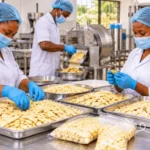
Food safety in food processing is one of the most important parts of food processing. A product may look attractive and have a good taste, but poor handling can still make it unsafe.
Food can become contaminated at different stages, including sourcing, transportation, washing, processing, packaging and storage.
Common types of food contamination
Biological contamination: This can involve harmful bacteria, viruses, parasites and moulds.
Chemical contamination: This may result from unsuitable cleaning chemicals, pesticide residues, contaminants in raw materials or the inappropriate use of food additives.
Physical contamination: This involves foreign objects such as stones, pieces of metal, glass, plastic, hair or other unwanted materials.
Essential hygiene practices for food processors
Food businesses should establish clear hygiene procedures and make sure that everyone handling food understands and follows them.
Important practices include:
– Use safe and suitable water for food processing.
– Wash hands properly before handling food and after activities that may contaminate them.
– Clean and sanitise food-contact surfaces and equipment appropriately.
– Keep raw materials separate from finished products.
– Protect food from insects, rodents, dust and other contaminants.
– Use suitable protective clothing and hair coverings.
– Store ingredients and finished products under appropriate conditions.
– Remove waste regularly and maintain a clean processing environment.
– Inspect raw materials before accepting them for production.
The World Health Organization’s Five Keys to Safer Food provide useful guidance: keep clean, separate raw and cooked food, cook thoroughly, keep food at safe temperatures, and use safe water and raw materials.
What is HACCP in food processing?
HACCP means Hazard Analysis and Critical Control Points. HACCP in food processing is a preventive food safety system used to identify, assess and control hazards that could make food unsafe.
Rather than relying only on inspecting finished products, HACCP encourages food businesses to examine the entire process and identify where hazards may occur.
For example, a dried food processor may need to consider raw material contamination, washing water quality, drying conditions, handling after drying and packaging.
HACCP works alongside good hygiene practices and good manufacturing practices. It should be supported by proper records, staff training and monitoring.
Food Processing, Nutritional Value and Gut Health
Food processing can affect the nutritional composition, texture, digestibility and availability of food components. The effect depends on the food and the method used.
Some processes improve food safety and make nutrients easier to access. Others may reduce certain heat-sensitive nutrients or change the amount of fibre and other food components.
How processing affects nutrients
Washing, peeling, heating, drying, milling and fermentation can all influence the nutritional quality of food.
For example, excessive heat or prolonged exposure to unsuitable drying conditions may reduce some heat-sensitive vitamins. On the other hand, appropriate cooking can make certain foods easier to digest and can improve the availability of some nutrients.
The aim should not simply be to process food as much as possible. It should be to use a suitable method that achieves the intended purpose while maintaining acceptable nutritional and sensory quality.
Fermentation and gut health
Fermentation is an important part of many traditional food systems. It can change the flavour, texture and composition of foods.
Some fermented foods contain live microorganisms when consumed, but this depends on the production method and whether the organisms survive processing and storage. It is therefore important not to describe every fermented food as probiotic without evidence.
Resistant starch and plant-based foods
Some foods, including unripe plantain, contain resistant starch. Resistant starch is a type of starch that is not fully digested in the small intestine and can be fermented by microorganisms in the large intestine.
The amount of resistant starch in a food can be influenced by its maturity, cooking method and cooling conditions.
This is one reason food processing deserves attention not only from a preservation and manufacturing perspective but also from a nutritional perspective.
Traditional and Modern Food Processing in Nigeria
Traditional food processing methods remain important in Nigeria because they reflect local knowledge, food culture and established ways of preparing and preserving agricultural products.
Examples include fermentation of cereals, cassava processing, traditional drying, smoking and the preparation of local spices.
Modern processing technologies can improve consistency, capacity, hygiene control and product monitoring. Examples include controlled-temperature dryers, mechanical washing systems, automated weighing equipment and improved packaging technology.
Traditional and modern methods do not have to compete. A business can preserve the identity and desirable qualities of a traditional food while improving the cleanliness, consistency and control of its production process.
The important consideration is whether the method produces food that is safe, suitable for consumption and consistent with the intended product quality.
NAFDAC and Food Processing Business Requirements in Nigeria
Food businesses producing or packaging products for sale in Nigeria should understand the applicable regulatory requirements before launching their products.
The National Agency for Food and Drug Administration and Control (NAFDAC) regulates food products and related activities within its mandate. Requirements can depend on the product category, manufacturing arrangement, facility, scale of operation and applicable regulations.
Depending on the product and business, relevant considerations may include:
– Appropriate business and product documentation.
– Facility inspection and compliance with applicable hygiene and manufacturing requirements.
– Product formulation and manufacturing information.
– Product testing and quality documentation where required.
– Appropriate packaging and labelling.
– Product registration or other applicable regulatory approvals.
Do not assume that requirements for one food product automatically apply to another. A packaged spice, bottled beverage, flour product and snack may have different considerations.
Businesses should consult NAFDAC’s current official guidelines and confirm the requirements for their specific product and production arrangement. This article provides a general introduction, not a substitute for current regulatory guidance.
How to Start a Food Processing Business in Nigeria
Starting a food processing business in Nigeria requires planning beyond buying raw materials and machinery. A good business idea must be supported by product knowledge, reliable sourcing, food safety, suitable equipment and a clear market.
1. Choose a product and understand its market
Research the food product you intend to process. Understand who will buy it, how it is used, what packaging customers prefer and what alternatives are already available.
Possible areas include spices, plantain products, tomato products, cassava products, bambara nut flour, dried fruits snacks and other processed agricultural products.
2. Identify reliable raw material suppliers
The quality of the finished product begins with the quality of the raw materials.
Establish clear purchasing standards. Consider freshness, maturity, cleanliness, variety, moisture condition and other characteristics relevant to your product.
3. Develop a suitable processing method
Understand the steps involved in producing your intended product. Document the process and identify where quality and safety checks are needed.
Do not depend entirely on guesswork or informal measurements when developing a process for commercial production.
4. Select appropriate equipment
Choose equipment based on the product, production capacity, available power supply, maintenance needs and budget.
A small business may begin with manual or semi-automatic equipment, while a larger operation may require more advanced machinery.
5. Establish hygiene and quality control procedures
Develop cleaning schedules, raw material inspection procedures, staff hygiene rules, storage practices and production records.
These procedures help make product quality more consistent and reduce avoidable contamination risks.
6. Understand regulatory requirements
Before manufacturing or selling regulated packaged food products, identify the applicable requirements and seek guidance from the relevant authorities.
7. Develop suitable packaging and distribution
Packaging should protect the product and provide the information required by applicable regulations. Distribution and storage conditions should also be suitable for the product.
Common Challenges Facing Food Processing Businesses in Nigeria
Although the food processing industry offers opportunities, businesses may face challenges that affect production and profitability.
Some common challenges include:
- Inconsistent supply and quality of agricultural raw materials.
- High equipment acquisition and maintenance costs.
- Unreliable electricity and energy expenses.
- Inadequate storage and cold-chain facilities.
- Poor handling and post-processing contamination.
- Packaging material costs.
- Limited technical knowledge and staff training.
- Difficulty meeting quality and regulatory requirements.
- Competition and changing consumer preferences.
Businesses can manage some of these challenges through better sourcing arrangements, production planning, appropriate technology, staff training and quality control.
The Future of Food Processing in Nigeria
The future of food processing in Nigeria will depend on how effectively businesses combine agricultural resources, appropriate technology, food safety and market knowledge.
Areas with potential for growth include:
- Improved small scale solar and energy-efficient drying systems.
- Better food packaging and shelf-life management.
- Mechanised sorting, cutting and milling.
- Small-scale and medium-scale food processing equipment.
- Improved cold storage and distribution.
- Food quality testing and traceability.
- Value addition to locally available agricultural products.
- Research into traditional foods and improved processing methods.
- There is also an opportunity to build stronger connections between farmers, processors, equipment manufacturers, researchers, regulators and consumers.
For food businesses, the goal should not be to adopt technology simply because it is modern. The right technology is the one that improves product safety, quality, efficiency and commercial sustainability.
Frequently Asked Questions About Food Processing in Nigeria
What are the common methods of food processing in Nigeria?
Common methods include drying, fermentation, milling, grinding, smoking, freezing, refrigeration, heat processing, peeling, cutting and packaging. The appropriate method depends on the food product and the intended outcome.
What food products can be processed in Nigeria?
Nigeria has many agricultural products suitable for processing, including cassava, plantain, maize, rice, sorghum, millet, fruits, vegetables, fish, pepper and other spices.
What machines are needed to start a food processing business?
The machines required depend on the product. A business processing spices may need cleaning, drying and grinding equipment, while a plantain chips business may require peeling, slicing, frying and packaging equipment.
Does food processing reduce nutritional value?
Not necessarily. Some processing methods can reduce certain nutrients, while others can improve food safety, digestibility or the availability of selected nutrients. The effect depends on the food and the processing conditions.
How does food processing help preserve food?
Methods such as drying, freezing, refrigeration, fermentation and suitable heat treatment can slow deterioration or reduce the conditions that allow microorganisms to grow. Each method has specific limitations and storage requirements.
Is food processing a profitable business in Nigeria?
Food processing can offer business opportunities because it adds value to agricultural produce and serves consumer and commercial markets. However, profitability depends on raw material costs, production efficiency, equipment, product quality, packaging, distribution, competition and demand.
What is the role of NAFDAC in food processing?
NAFDAC regulates food products and related activities within its mandate. Food businesses should check the current requirements that apply to their particular products, facilities and production arrangements.
Conclusion
Food processing in Nigeria is an important link between agriculture, food preservation, manufacturing and consumer needs. It creates opportunities to reduce post-harvest losses, add value to local produce, improve convenience and develop sustainable food businesses.
However, successful food processing requires more than equipment and production capacity. It depends on suitable processing methods, reliable raw materials, good hygiene, food safety controls, appropriate packaging and compliance with applicable regulations.
Whether a business is sorting and cleaning agricultural produce, drying spices, milling grains, fermenting traditional foods or manufacturing packaged snacks, the objective should remain the same: produce food that is safe, consistent and suitable for its intended use.
D’Omega Foods: Processing Clean. Quality You Can Trust.